
Understanding health insurance costs can be confusing, especially when terms such as premium, deductible, copay, and coinsurance appear together in a policy. These four terms describe different ways individuals and insurance companies share the cost of healthcare in the United States. A premium is the amount paid to maintain coverage, a deductible is what a policyholder pays toward certain covered services before the plan begins sharing costs, a copay is a fixed payment for a service, and coinsurance is a percentage of an eligible medical expense. Knowing the difference between these terms makes it easier to understand insurance bills, estimate potential healthcare expenses, and read policy documents.
1. Understanding the Four Main Health Insurance Cost Terms
Health insurance involves several types of payments, and each serves a different purpose. Although premiums, deductibles, copayments, and coinsurance all affect how much a person spends on healthcare, they are not interchangeable.
Here is a simple explanation of each term.
- Premium: The regular amount paid to keep a health insurance policy active.
- Deductible: The amount a policyholder pays toward certain covered healthcare services before the insurer starts sharing costs under the plan’s deductible rules.
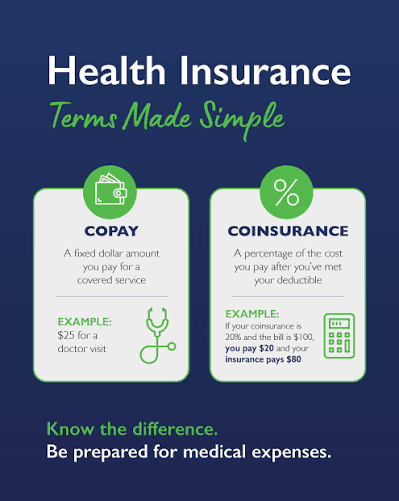
- Copay: A fixed amount paid for a particular covered service, such as a doctor’s appointment or prescription.
- Coinsurance: The percentage of an eligible healthcare expense that the policyholder pays after satisfying the applicable deductible.
These costs work together to determine an individual’s financial responsibility when receiving medical care.
For example, someone may pay a monthly premium throughout the year, meet a deductible after receiving medical treatment, pay copayments for certain appointments, and owe coinsurance for hospital services.
Not every health insurance plan uses these cost-sharing arrangements in exactly the same way. Requirements vary by policy, provider network, type of service, and applicable federal and state regulations.
2. What Is a Health Insurance Premium?
A health insurance premium is the regular payment required to maintain an insurance policy. It is generally paid monthly, although payment arrangements can differ depending on the coverage.
Premiums are important because they keep the insurance arrangement active, even when the policyholder does not visit a doctor or receive medical treatment.
How Premiums Work
When someone enrolls in a health insurance plan, they agree to pay the required premium according to the policy’s payment schedule.
For employer-sponsored insurance, an employer may pay part of the premium while the employee contributes the remaining amount. For individual health insurance, the policyholder generally pays the premium directly, although eligible individuals may receive financial assistance under applicable government rules.
Several factors can influence health insurance premiums, including:
- The type of insurance coverage.
- The policyholder’s location.
- The number of people covered under the policy.
- The plan’s benefits and cost-sharing structure.
- Applicable rating rules and eligibility requirements.
The factors used to determine premiums can differ between employer-sponsored coverage, individual insurance, Medicare-related coverage, and other programs.
Important Things to Remember About Premiums
Paying a premium does not mean all medical expenses are automatically covered. Policyholders may still have to satisfy deductibles, pay copayments, or contribute coinsurance when receiving eligible healthcare services.
Premiums are also generally separate from deductibles and out-of-pocket maximums. Paying premiums does not usually reduce the deductible or count toward the plan’s out-of-pocket maximum.
3. What Is a Health Insurance Deductible?
A health insurance deductible is the amount a policyholder must pay for certain covered healthcare services before the insurance company begins sharing expenses according to the policy.
Deductibles help determine when cost-sharing responsibilities shift between the insured individual and the insurance company.
How Deductibles Work
Imagine someone has a health insurance policy with a $1,000 deductible. During the coverage period, they receive eligible medical services that are subject to the deductible.
The policyholder generally pays the applicable insurer-approved costs until the deductible is satisfied. After that, the insurance company begins contributing according to the plan’s copayment or coinsurance requirements.
However, some healthcare services may be covered before the deductible is met. For example, certain preventive services under qualifying plans may be available without cost-sharing when applicable requirements are satisfied.
Hypothetical Example 1: Understanding a Deductible
Imagine a policyholder has a $1,000 annual deductible and receives a covered medical service with an insurer-approved cost of $1,500.
Assuming the deductible has not previously been met and the entire service is subject to it:
- The policyholder pays the first $1,000.
- The remaining $500 is subject to the plan’s applicable cost-sharing rules.
- The insurer pays its share according to the policy.
The policyholder’s total responsibility may therefore be higher than the deductible, depending on the coinsurance or other charges that apply.
This example is hypothetical and illustrative only. Actual expenses depend on the policy, covered service, and approved amount.
Individual and Family Deductibles
Some health insurance plans have separate individual and family deductibles.
An individual deductible applies to one covered person. A family deductible considers eligible healthcare expenses incurred by multiple covered family members.
Depending on the policy, a family plan may use an embedded deductible, in which an individual can satisfy their own deductible, or an aggregate deductible, in which the family deductible must be met before the plan begins sharing certain costs for covered members.
Understanding which arrangement applies can help families interpret their healthcare expenses.
4. What Is a Health Insurance Copay?
A copayment, commonly called a copay, is a fixed amount a policyholder pays for a particular covered healthcare service.
Unlike coinsurance, which is calculated as a percentage, a copay is generally a predetermined dollar amount established by the insurance policy.
How Copays Work
A health insurance plan may require different copayments for different types of services.
For example, a policy may establish separate copays for:
- Primary care appointments.
- Specialist consultations.
- Urgent care visits.
- Certain prescription medications.
- Other eligible healthcare services.
The actual amounts depend on the policy and may differ between in-network and out-of-network services.
Some plans require copayments even after the deductible has been met. Other plans may apply the deductible first, depending on the service and benefit structure.
Hypothetical Example 2: Understanding a Copay
Imagine someone has a health insurance plan requiring a $30 copayment for an eligible primary care appointment.
The healthcare provider charges an insurer-approved amount of $150 for the visit. If the service is covered under the plan’s copayment arrangement, the patient pays $30 and the insurance company generally pays the remaining eligible amount.
The copayment may apply even if the policyholder has not met the deductible, depending on the policy.
This example is hypothetical and illustrative only. Actual payments depend on coverage terms and applicable provider arrangements.
Are Copays the Same as Deductibles?
No. A deductible is an accumulated amount that a policyholder must pay toward certain covered services, while a copay is a fixed payment associated with a particular service.
For example, paying a copay for a doctor’s appointment does not necessarily reduce the deductible. Whether a particular payment counts toward the deductible depends on the plan’s rules.
5. What Is Health Insurance Coinsurance?
Coinsurance is the percentage of an eligible healthcare expense that the policyholder pays after meeting the applicable deductible.
The insurance company generally pays the remaining percentage of the insurer-approved amount for covered services, subject to the policy’s terms.
Unlike a copayment, coinsurance is not a fixed dollar amount. It changes according to the cost of the covered service.
How Coinsurance Works
Suppose a health insurance plan requires 20% coinsurance after the deductible has been satisfied.
For a covered service with an insurer-approved cost of $1,000:
- The policyholder pays 20%, or $200.
- The insurance company pays the remaining 80%, or $800.
The percentage is applied to the amount recognized under the plan’s coverage and pricing arrangements, not necessarily the provider’s original billed charge.
Hypothetical Example 3: Understanding Coinsurance
Imagine a policyholder has already met the applicable deductible. They receive a covered hospital service with an insurer-approved cost of $5,000.
Their policy requires 20% coinsurance.
The calculation would be:
- Approved medical expense: $5,000.
- Policyholder’s coinsurance: 20%, or $1,000.
- Insurance company’s share: 80%, or $4,000.
The policyholder would generally owe $1,000, assuming no additional copayments or other charges apply and the service is covered under the policy.
This example is hypothetical and illustrative only. Actual financial responsibility depends on the policy, network arrangements, and applicable cost-sharing rules.
Why Coinsurance Matters
Coinsurance can make a significant difference when medical services are expensive because the patient’s share is calculated as a percentage of the approved cost.
For this reason, understanding the coinsurance percentage and how it interacts with the deductible and out-of-pocket maximum is an important part of understanding health insurance expenses.
6. Key Differences Between Premium, Deductible, Copay, and Coinsurance
Although these four terms are related, each represents a different financial responsibility.
The following table summarizes their main differences.
| Insurance term | What it means | How you pay |
|---|---|---|
| Premium | Cost of maintaining coverage | Regular payments, usually monthly |
| Deductible | Amount paid toward certain covered services before cost-sharing begins | Payments for eligible medical services |
| Copay | Fixed payment for a covered service | Set dollar amount per applicable service |
| Coinsurance | Percentage of an eligible medical expense | Percentage of the approved cost |
How These Costs Work Together
Consider a hypothetical health insurance plan with the following features:
- Monthly premium: $300.
- Annual deductible: $1,000.
- Primary care copay: $30.
- Coinsurance: 20% after the deductible.
A policyholder pays the premium to maintain coverage. When they receive certain healthcare services, they may have to pay the deductible before coinsurance applies.
For eligible primary care visits, the plan may require a $30 copayment, depending on its rules. For other covered services, the policyholder may pay the applicable deductible first and then contribute 20% coinsurance.
This example demonstrates that these costs are separate parts of the insurance arrangement. Paying one does not automatically eliminate the others.
What Is an Out-of-Pocket Maximum?
Another important term is the out-of-pocket maximum.
It is the limit on how much a policyholder pays toward qualifying covered healthcare expenses during a coverage period.
Under applicable rules, once this limit is reached, the plan generally pays 100% of covered in-network essential health benefits for the remainder of the period.
However, premiums, noncovered services, and certain out-of-network expenses generally do not count toward this maximum.
The specific rules depend on the coverage arrangement. Medicare, Medicaid, employer-sponsored insurance, and individual marketplace plans can have different cost-sharing structures.
7. Common Mistakes and How to Understand Your Insurance Costs
People sometimes confuse health insurance terms because several payments may appear on the same medical bill or insurance statement.
Understanding common misunderstandings can make insurance documents easier to interpret.
Mistake 1: Assuming Premiums Count Toward the Deductible
Premiums and deductibles serve different purposes. Paying monthly premiums generally does not reduce the amount remaining on a policyholder’s deductible.
Mistake 2: Assuming Every Service Requires Meeting the Deductible First
Some services may be covered before the deductible is met. Certain qualifying preventive services, for example, may be available without cost-sharing under applicable rules.
Mistake 3: Confusing Copays With Coinsurance
A copay is a fixed payment, while coinsurance is a percentage of an eligible expense. The two may apply to different services or, in some situations, to the same episode of care under the policy’s rules.
Mistake 4: Assuming the Insurance Company Pays Every Remaining Expense
Insurance coverage has limits, exclusions, and conditions. Noncovered services, certain out-of-network charges, and services that do not meet policy requirements may leave the policyholder responsible for additional expenses.
Practical Ways to Understand Your Health Insurance Costs
Policyholders can become more familiar with their financial responsibilities by reviewing:
- The Summary of Benefits and Coverage (SBC).
- The policy’s deductible and coinsurance requirements.
- Copayments for different healthcare services.
- The annual out-of-pocket maximum.
- Provider network information.
- Exclusions and prior authorization requirements.
- Explanation of Benefits (EOB) statements.
These documents can help explain how an insurer processes claims and determines the amount a policyholder may owe.
8. Frequently Asked Questions
1. What is the difference between a premium and a deductible?
A premium is the regular payment required to maintain health insurance coverage. A deductible is the amount a policyholder pays toward certain covered healthcare services before the insurance plan begins sharing costs under its deductible rules. Premiums are generally paid regardless of healthcare usage, while deductible payments arise when applicable medical services are received.
2. Is a copay paid before or after the deductible?
It depends on the health insurance plan and the type of service. Some policies require copayments before the deductible is met, while others apply the deductible first. Certain services may have separate cost-sharing arrangements. Reviewing the plan’s Summary of Benefits and Coverage can help clarify when copayments apply.
3. Is coinsurance better than a copay?
Coinsurance and copayments are different cost-sharing methods, and neither is automatically better in every situation. A copay is a fixed payment, while coinsurance changes according to the approved cost of a covered service. The financial effect depends on the healthcare service, the policy’s terms, and the applicable deductible.
4. Do health insurance premiums count toward the out-of-pocket maximum?
Generally, no. Health insurance premiums are separate from the out-of-pocket maximum. The maximum typically tracks qualifying cost-sharing expenses, such as applicable deductibles, copayments, and coinsurance. Noncovered services and certain out-of-network expenses may also be excluded. Specific counting rules depend on the insurance program and applicable regulations.
5. Can you have a deductible, copay, and coinsurance in the same health insurance plan?
Yes. Many health insurance plans use all three cost-sharing arrangements. A policyholder may pay a deductible for certain services, a fixed copay for an office visit, and coinsurance for eligible hospital or specialist services. The exact combination depends on the policy’s benefit structure and the type of medical care received.
Conclusion
Understanding the difference between a health insurance premium, deductible, copay, and coinsurance is essential for interpreting healthcare expenses in the United States. Each term describes a separate part of how medical costs are shared between policyholders and insurance providers. Premiums maintain coverage, deductibles establish an initial cost-sharing responsibility, copays provide fixed payments for certain services, and coinsurance represents a percentage of eligible medical expenses. Although these concepts are relatively straightforward, their application varies between insurance policies and government programs. Reviewing coverage documents and understanding applicable cost-sharing rules can help individuals make sense of their healthcare financial responsibilities.
Sources and Further Reading
The following US organizations provide educational information about health insurance costs, coverage requirements, consumer protections, and insurance regulation.
- HealthCare.gov – Explains health insurance terminology, including premiums, deductibles, copayments, coinsurance, and out-of-pocket costs.
https://www.healthcare.gov/glossary/ - National Association of Insurance Commissioners (NAIC) – Provides consumer education and information about insurance regulation and state insurance departments.
https://content.naic.org/ - Medicare.gov – Provides official information about Medicare coverage, premiums, deductibles, coinsurance, and other beneficiary costs.
https://www.medicare.gov/ - Insurance Information Institute (III) – Offers educational information about insurance concepts, healthcare coverage, and financial protection.
https://www.iii.org/ - Consumer Financial Protection Bureau (CFPB) – Provides consumer resources about medical bills, healthcare debt, and related financial issues.
https://www.consumerfinance.gov/ - Your State Department of Insurance – Provides state-specific information about insurance regulations, consumer rights, and coverage-related complaints. Official state department directories are available through the NAIC.
https://content.naic.org/state-insurance-departments
Disclaimer
This article is intended for educational purposes only and does not constitute insurance, financial, tax, medical, or legal advice. No guarantees or promises are made regarding coverage, claim approval, savings, premiums, or any other insurance-related results. All examples are hypothetical and provided solely to explain general insurance concepts. This article does not state time-sensitive figures such as premiums, deductibles, coverage limits, or enrollment dates; readers should consult official sources, including HealthCare.gov, Medicare.gov, the NAIC, or their state Department of Insurance, for current information. Readers should consult a licensed insurance professional or qualified advisor before making insurance decisions.
About the Author
[Author Name] is [credentials/experience in insurance, finance, writing, or research]. [One or two sentences about expertise.]