
1. What Is an Insurance Claim?
An insurance claim is a formal request made by a policyholder or an eligible beneficiary asking an insurance company to provide benefits or compensation under an insurance policy.
Claims can involve different situations, including vehicle accidents, property damage, theft, medical treatment, disability, or the death of an insured person.
The insurance company reviews the request to determine whether the incident is covered and how much it may owe under the contract.
Who Is Involved in an Insurance Claim?
Several people may participate in the claims process:
- Policyholder: The person who owns the insurance policy.
- Claimant: The person or party requesting insurance benefits.
- Insurance adjuster: A professional who investigates a claim and evaluates the reported loss.
- Insurance company: The organization responsible for reviewing the claim and determining benefits under the policy.
- Beneficiary: A person designated to receive benefits under certain policies, such as life insurance.
Not every claim involves all these individuals. The participants depend on the insurance type and circumstances of the loss.
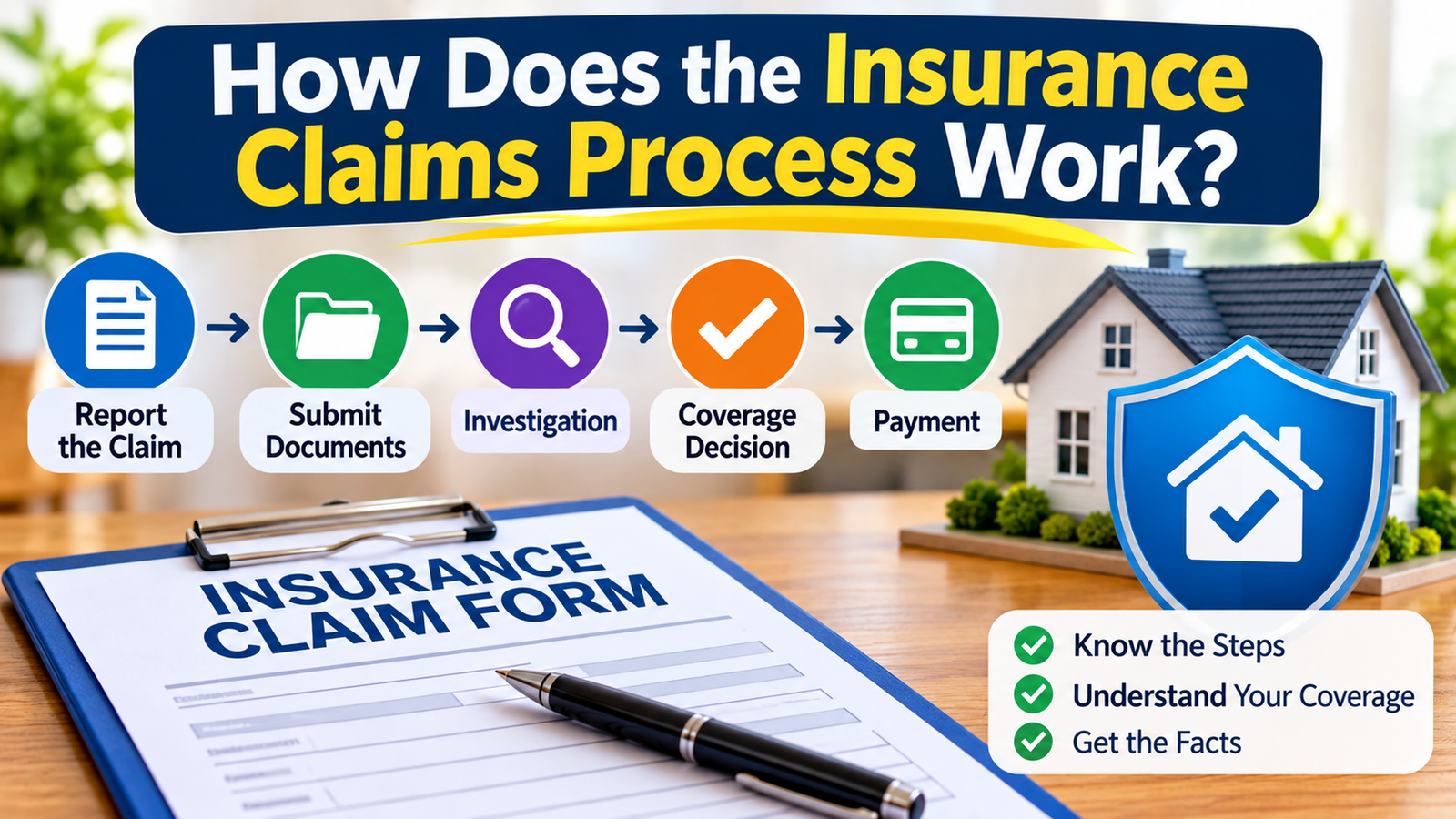
2. Step-by-Step: How Does the Insurance Claims Process Work?
Although procedures vary, many insurance claims follow a similar sequence.
Step 1: Report the Incident
The process generally begins when the policyholder notifies the insurance company about an incident that may be covered.
For example, a driver involved in an accident may contact the auto insurer, while a homeowner experiencing storm damage may report the property loss.
Policyholders should check their contracts for reporting requirements and notify the insurer within the applicable period.
When reporting an incident, useful information may include:
- Policy number and contact details
- Date, time, and location of the incident
- Description of what happened
- Names and contact information of other parties
- Photographs or other available evidence
Reporting an incident does not automatically mean a claim will be approved.
Step 2: Submit the Claim Form and Supporting Documents
After receiving the initial notification, the insurance company may provide a claim form or instructions for submitting information.
The required documentation depends on the type of insurance and the nature of the loss.
Examples include:
- Police or accident reports
- Medical bills and treatment records
- Repair estimates and invoices
- Photographs of damaged property
- Receipts and purchase records
- Proof of ownership
- Death certificates for applicable life insurance claims
Providing complete and accurate information can help the insurer evaluate the request. Missing documents or inconsistent information may require additional clarification.
Step 3: Claim Registration and Initial Review
Once the insurer receives the claim, it generally creates a claim file and assigns a reference number.
The claims department reviews the available information to confirm details such as:
- Whether the policy was active on the date of the incident
- Whether the person making the claim is eligible
- Which coverage provisions may apply
- Whether deductibles or exclusions are relevant
- What additional information may be required
The initial review helps determine how the claim should proceed. It does not necessarily establish the final amount payable.
Step 4: Investigation and Damage Assessment
Many claims require an investigation before the insurance company makes a decision.
A claims adjuster may review documents, interview involved individuals, inspect damaged property, or request additional evidence.
For example, an auto insurance adjuster may inspect a damaged vehicle and compare repair estimates with the reported accident details.
A property insurance adjuster may examine the building, review photographs, and estimate the cost of repairing covered damage.
The investigation is intended to establish the circumstances of the loss, assess the damage, and determine how the policy applies.
Step 5: Coverage Decision and Claim Evaluation
After reviewing the evidence, the insurance company evaluates the claim against the policy’s terms and applicable state requirements.
The insurer may consider:
- Covered causes of loss
- Policy exclusions and limitations
- Deductibles and coverage limits
- The actual value or replacement cost of damaged property
- Whether the reported event meets policy conditions
The insurer may approve the entire claim, approve only part of it, request more information, or deny coverage.
The decision should be explained through the insurer’s claims communication. If coverage is denied or limited, the policyholder can review the explanation and the relevant policy provisions.
Step 6: Settlement and Payment
If the claim is approved, the insurance company determines the applicable payment according to the policy.
Payment arrangements vary. For example, an auto repair payment may be issued to the policyholder or repair facility, while certain homeowners insurance payments may involve both the homeowner and mortgage lender.
Health insurance claims generally involve payments between the insurer and healthcare provider, although the insured person may remain responsible for deductibles, copayments, coinsurance, or noncovered services.
Life insurance benefits are generally paid to eligible beneficiaries after the insurer verifies the claim and required documentation.
Step 7: Claim Closure
A claim may be closed after the insurer completes its evaluation and settlement responsibilities.
However, some situations involve additional payments, supplemental documentation, reopened claims, or disputes.
Policyholders should keep settlement letters, payment records, estimates, and related correspondence for their personal records.
3. What Happens During an Insurance Claim Investigation?
An investigation helps an insurer determine what happened and whether the reported loss falls within the policy’s coverage.
The level of investigation depends on the claim’s complexity, type, and circumstances.
The Role of an Insurance Adjuster
An insurance adjuster evaluates claims on behalf of an insurance company or another party.
Adjusters may:
- Inspect damaged property or vehicles
- Review photographs and repair estimates
- Examine supporting documents
- Interview claimants and witnesses
- Assess the reported financial loss
- Prepare findings for the insurer’s coverage decision
Some adjusters work directly for insurance companies, while others work independently.
A public adjuster, where permitted by state law, generally represents the policyholder in evaluating and presenting a property insurance claim. Public adjusters typically charge fees for their services.
Why Can an Investigation Take Time?
An investigation may take longer when:
- Damage is extensive or difficult to assess.
- Several people or insurance policies are involved.
- Medical records or other documents are incomplete.
- The cause of damage is disputed.
- Additional inspections or expert assessments are necessary.
- A major disaster creates a large number of claims.
Insurance companies must follow applicable state laws and policy requirements. Claim-handling deadlines are not identical across all states or insurance types.
4. How Deductibles, Coverage Limits, and Exclusions Affect Claims
A claim’s approval does not necessarily mean the insurer will pay the entire amount requested.
Three important policy features can influence the final settlement.
Understanding the Deductible
A deductible is the amount a policyholder must pay toward an eligible covered loss before the insurer pays the remaining covered amount.
Hypothetical Example 1:
Imagine a driver has an auto insurance policy with a $1,000 deductible and experiences a covered accident resulting in $5,000 of eligible vehicle damage.
If the entire amount is approved and no other adjustments apply, the insurer may pay $4,000, while the driver is responsible for the $1,000 deductible.
This example is hypothetical and illustrative only.
Understanding Coverage Limits
A coverage limit is the maximum amount an insurer may pay for a particular type of covered claim.
For example, a homeowners policy may have separate limits for the dwelling, personal belongings, and liability protection.
If an eligible loss exceeds the applicable limit, the policyholder may be responsible for the amount above that limit.
Understanding Policy Exclusions
Exclusions identify situations, events, or types of losses that the insurance policy does not cover.
For example, standard homeowners insurance generally excludes certain flood-related losses, although separate flood insurance may provide protection.
Policyholders should review the actual contract because exclusions, exceptions, and optional endorsements vary among policies and states.
Hypothetical Example 2: A Property Damage Claim
Imagine a homeowner reports $12,000 in damage following a covered event. The policy has a $2,000 deductible, and the insurer determines that $10,000 of the reported damage is eligible for payment before the deductible.
If no other limitations apply, the insurer may pay $8,000.
The final payment could differ if the policy uses depreciation, special coverage limits, or other settlement provisions.
This example is hypothetical and illustrative only.
5. Why Might an Insurance Claim Be Delayed or Denied?
Not every insurance claim is approved immediately. Some require additional investigation, while others may be denied because the reported loss does not qualify for coverage.
Common Reasons for Delays
- Missing claim forms or supporting documents
- Incomplete medical or repair records
- Difficulty verifying the cause of loss
- Disagreements about damage estimates
- Multiple parties involved in the incident
- Delays in obtaining third-party reports
Policyholders can ask the insurer what information remains outstanding and whether any applicable deadlines need attention.
Common Reasons for Claim Denials
An insurance company may deny a claim for reasons such as:
- The policy does not cover the reported event.
- An exclusion applies.
- Coverage was not active when the loss occurred.
- The claimant does not qualify for the requested benefit.
- Required policy conditions were not satisfied.
- The evidence does not establish an eligible covered loss.
A denial does not necessarily mean the insurer’s decision is correct. Policyholders can request a written explanation and review the applicable contract provisions.
6. What Can You Do If an Insurance Claim Is Denied or Underpaid?
A claim denial or payment disagreement can be frustrating, but policyholders may have options for reviewing the decision.
Review the Denial Letter
Start by reading the insurer’s written explanation carefully.
Identify the specific policy provision, exclusion, or condition cited by the insurance company. Compare that explanation with the policy documents and the information submitted with the claim.
Request Clarification
If the decision is unclear, contact the claims department and ask for an explanation.
Questions may include:
- Which policy provision affected the decision?
- What evidence was considered?
- Which documents are still needed?
- How was the approved payment calculated?
- Is there an internal review or appeal procedure?
Submit Additional Evidence
If relevant information was missing or misunderstood, provide supporting documentation where permitted.
This could include photographs, receipts, medical records, repair estimates, or other evidence related to the claim.
For some property claims, the policy may contain an appraisal procedure for disagreements about the amount of a covered loss. The procedure and its availability depend on the contract.
Contact Your State Department of Insurance
If a disagreement remains unresolved, consumers may contact their state Department of Insurance.
State insurance regulators can explain applicable consumer protections and may investigate complaints involving unfair claim delays, improper denials, or other potential violations.
Their authority and procedures vary by state. They do not generally act as personal legal representatives for policyholders.
7. Different Types of Insurance Claims
Although the general claims process is similar, the documents, investigations, and payment arrangements differ by insurance category.
Auto Insurance Claims
Auto insurance claims commonly involve vehicle accidents, theft, vandalism, or other covered vehicle damage.
The insurer may review accident reports, photographs, repair estimates, witness information, and liability details. Payment depends on the coverage involved, the circumstances of the accident, and the policy provisions.
Homeowners and Renters Insurance Claims
These claims may involve fire, theft, storms, accidental water damage, or other covered property losses.
The insurer may inspect the property, review an inventory of damaged belongings, and evaluate repair estimates. Additional living expenses may also be considered when a covered event makes the home temporarily uninhabitable and the policy includes applicable coverage.
Health Insurance Claims
Health insurance claims generally involve healthcare providers submitting bills to an insurance company for covered medical services.
The insurer processes the claim according to the health plan’s benefits, network arrangements, medical necessity requirements, and cost-sharing provisions. An Explanation of Benefits (EOB) may show how a claim was processed, what the plan paid, and what amount may remain the patient’s responsibility.
An EOB is not necessarily a bill.
Life Insurance Claims
Life insurance claims are generally submitted by beneficiaries after the insured person’s death.
The insurer may request a claim form, death certificate, policy information, and other documents needed to verify eligibility. Once the claim is reviewed, the company determines whether benefits are payable under the policy.
Key Takeaways
- The insurance claims process generally involves reporting a loss, submitting documents, investigation, evaluation, and settlement.
- An insurance adjuster may inspect damage and assess the reported loss.
- Deductibles, coverage limits, and exclusions influence how much an insurer may pay.
- Claims can be delayed or denied because of missing information, policy exclusions, or coverage disputes.
- Policyholders can request explanations, provide additional evidence, and contact their state Department of Insurance when appropriate.
Frequently Asked Questions (FAQs)
1. How long does the insurance claims process take?
The time required depends on the insurance type, complexity of the loss, completeness of the documents, and applicable state requirements. Simple claims may be resolved relatively quickly, while complicated investigations can take longer. Policyholders can contact the claims department to ask about outstanding documents, applicable deadlines, and the expected next steps.
2. What documents are needed to file an insurance claim?
Required documents vary by claim. Common examples include the insurance policy number, completed claim forms, photographs, receipts, repair estimates, medical bills, police reports, and proof of ownership. Life insurance claims may require a death certificate and beneficiary documentation. The insurer can explain which records are necessary for a particular claim.
3. Does filing an insurance claim guarantee payment?
No. Filing a claim only begins the insurer’s review process. The company must determine whether the reported incident qualifies for coverage under the policy. Exclusions, deductibles, coverage limits, eligibility requirements, and missing information can affect the decision and final payment.
4. Can an insurance company deny a valid claim?
An insurer may deny a claim if it determines that the loss does not meet the policy’s coverage requirements. However, mistakes or disagreements about policy interpretation can occur. A policyholder who questions a denial can request a written explanation, review the relevant policy provisions, submit additional evidence, and contact the state insurance department if necessary.
5. What should I do if my insurance claim is taking too long?
Contact the claims department and request an update about the investigation and any outstanding documentation. Keep records of conversations, emails, and submitted documents. Ask about the applicable claim-handling deadlines in your state. If communication or handling remains a concern, the state Department of Insurance may provide consumer assistance.
Conclusion
Understanding how the insurance claims process works can help policyholders navigate an unfamiliar situation with greater confidence. Most claims involve reporting an incident, submitting supporting documents, cooperating with an investigation, and reviewing the insurer’s coverage decision. However, the process and payment requirements vary by insurance type, policy terms, and state regulations. Knowing how deductibles, exclusions, coverage limits, and appeals work can help consumers understand their responsibilities and available options. Keeping organized records and communicating clearly with the insurance company are useful practices throughout the claims process.
Sources and Further Reading
The following US organizations provide reliable educational information about insurance claims, consumer rights, and state insurance regulation.
1. National Association of Insurance Commissioners (NAIC): Explains auto insurance claims, documentation, adjusters, and consumer complaint procedures.
https://content.naic.org/article/what-you-should-know-about-filing-auto-claim
2. Insurance Information Institute (Triple-I): Provides guidance on filing auto and homeowners insurance claims, documenting damage, and communicating with insurers.
https://www.iii.org/article/how-to-file-auto-insurance-claim
3. National Association of Insurance Commissioners (NAIC) – Navigating the Claims Process: Offers information about property damage claims, adjuster inspections, documentation, and claim payments.
https://content.naic.org/article/consumer_insight_navigating_claims_process_recover_rebuild.htm
4. NAIC – How to File an Insurance Complaint: Explains how consumers can contact their state insurance department when they have concerns about claim handling.
https://content.naic.org/consumer/how-to-file-complaint
5. Your State Department of Insurance: Provides state-specific information about insurance regulations, consumer rights, claim disputes, and complaint procedures.
https://content.naic.org/state-insurance-departments
Disclaimer
This article is provided for educational purposes only and does not constitute insurance, financial, tax, medical, or legal advice. No guarantees or promises are made regarding coverage, claim approval, savings, premiums, payments, or any other results. All examples are hypothetical and intended solely for illustration. This article does not state time-sensitive figures such as premiums, deductibles, coverage limits, or enrollment dates; readers should consult official sources such as HealthCare.gov, Medicare.gov, the NAIC, or their state Department of Insurance for current information. Consult a licensed insurance professional or qualified advisor before making insurance decisions.
About the Author
[Author Name] is [credentials/experience in insurance, finance, writing, or research]. [One or two sentences about expertise.] The author focuses on creating clear, accurate, and accessible educational content about insurance, consumer protection, and personal finance.