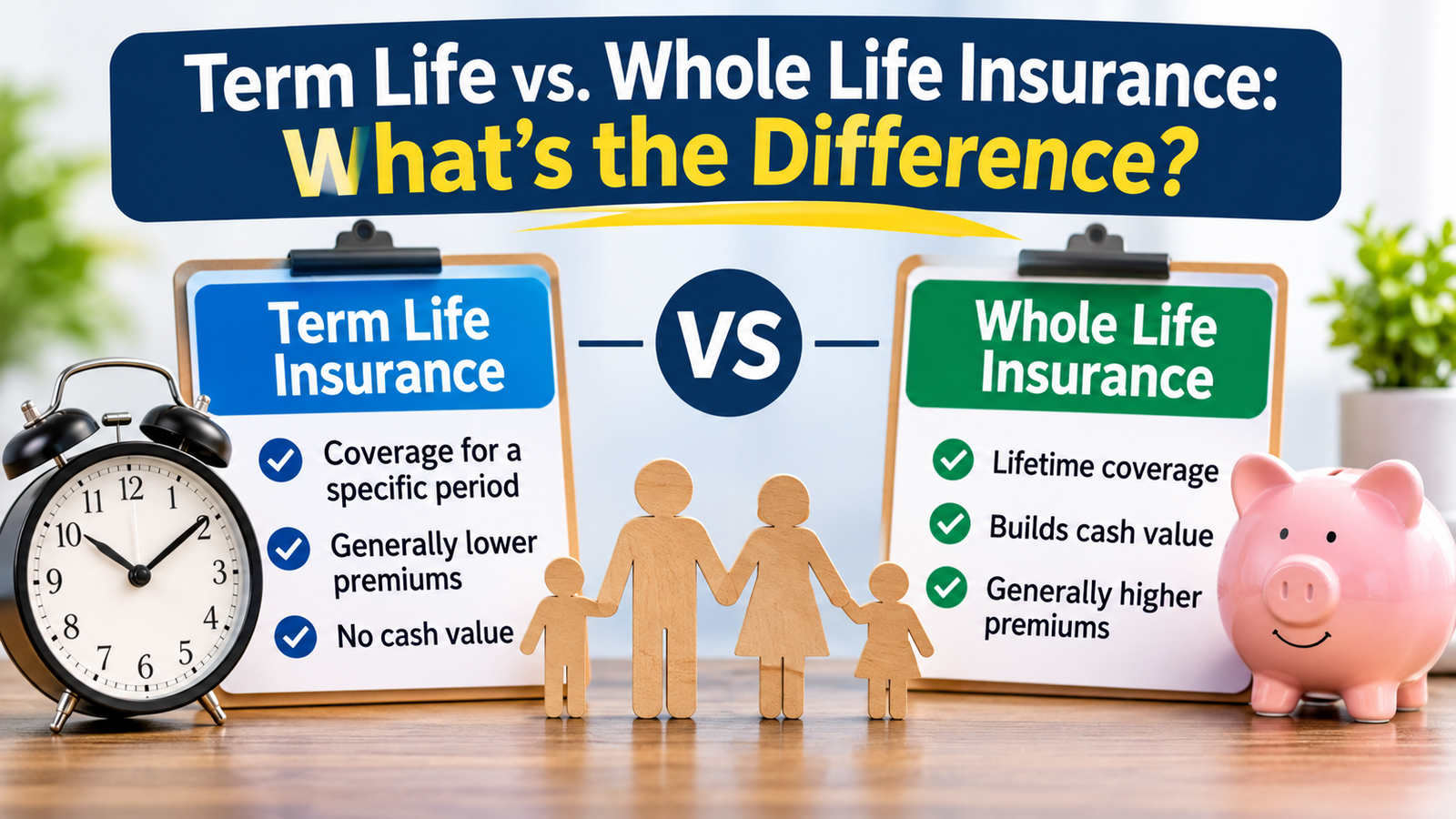
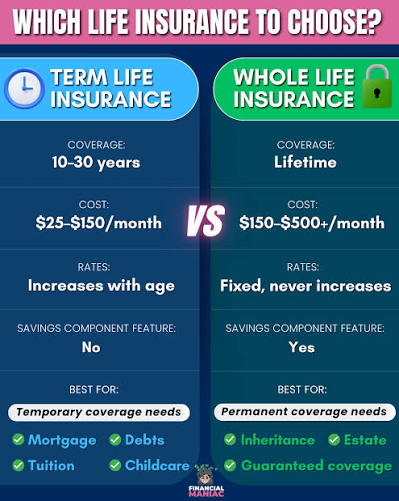
Life insurance can help protect the people who depend on you financially, but not all policies work the same way. The main difference between term life vs. whole life insurance is how long coverage lasts and whether the policy builds cash value. Term life insurance provides coverage for a specific period, such as 10, 20, or 30 years, while whole life insurance is designed to provide lifelong coverage as long as policy requirements are met. Whole life policies also accumulate cash value over time, whereas traditional term policies generally do not. Understanding these differences can help consumers learn how each type works, what it costs, and what limitations may apply.
1. What Is Term Life Insurance?
Term life insurance is a type of life insurance that provides financial protection for a specific period, known as the policy term. Depending on the contract, coverage may last for a set number of years or until a specified age.
If the insured person dies while the policy is active, the insurance company generally pays the stated death benefit to the named beneficiaries, subject to the policy’s terms and conditions.
If the insured person outlives the policy term, coverage typically ends without a death benefit being paid.
How Term Life Insurance Works
When purchasing a term life policy, the policyholder selects a coverage amount and a term length, subject to the insurer’s available options and underwriting requirements.
For example, a person might purchase a 20-year term policy with a $300,000 death benefit. If the insured dies during those 20 years while the policy remains in force, eligible beneficiaries may receive the $300,000 benefit.
Term life insurance is generally less expensive initially than whole life insurance because it provides temporary protection without building cash value.
Common Types of Term Life Insurance
Several variations of term coverage are available:
- Level term life insurance: The death benefit and scheduled premiums generally remain the same throughout the specified term.
- Decreasing term life insurance: The death benefit gradually decreases over the policy period. This type may be structured around a financial obligation that declines over time.
- Renewable term life insurance: Allows the policyholder to renew coverage under specified conditions, sometimes without additional medical underwriting. Renewal premiums may increase.
- Convertible term life insurance: Includes an option to convert eligible term coverage into a permanent policy within a specified period, subject to contract provisions.
Not every insurer offers every type. Renewal and conversion rights, deadlines, and costs depend on the policy.
2. What Is Whole Life Insurance?
Whole life insurance is a form of permanent life insurance designed to remain in force throughout the insured person’s lifetime, provided the policy requirements are satisfied.
Unlike traditional term life insurance, whole life insurance combines a death benefit with a cash value component. Part of the premium supports the cost of insurance and policy expenses, while another portion contributes to the policy’s cash value.
Traditional whole life policies generally have scheduled premiums that remain level under the contract. Their cash value grows according to the policy’s guaranteed provisions.
How Whole Life Insurance Works
When someone purchases a whole life policy, the insurance company establishes the initial death benefit and premium structure.
As premiums are paid, the policy accumulates cash value over time. This amount belongs to the policyholder under the contract and may become accessible through withdrawals, policy loans, or surrender.
However, accessing cash value can have financial consequences. Outstanding loans and interest may reduce the death benefit, while withdrawals or surrender may affect coverage and create potential tax consequences.
Important Features of Whole Life Insurance
Whole life insurance has several characteristics that distinguish it from term coverage:
- Lifetime coverage: Designed to provide coverage for the insured person’s lifetime if the contract remains in force.
- Cash value accumulation: Builds cash value over time according to the policy’s provisions.
- Level scheduled premiums: Traditional whole life policies generally maintain a predetermined premium schedule.
- Death benefit: Provides a benefit to eligible beneficiaries when the insured dies.
- Policy loans: May allow the policyholder to borrow against accumulated cash value, subject to interest and policy terms.
- Nonforfeiture options: Provide certain options when a policyholder stops paying premiums or surrenders coverage, as specified by the contract and applicable state law.
Some participating whole life policies may also pay dividends. However, dividends are generally not guaranteed and should not be confused with guaranteed policy values.
3. Term Life vs. Whole Life Insurance: Key Differences
Both types of insurance provide a death benefit, but their coverage periods, costs, and financial features are different.
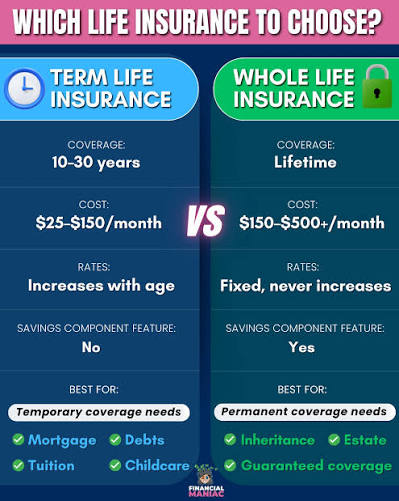
The following comparison highlights their main characteristics.
| Feature | Term Life Insurance | Whole Life Insurance |
|---|---|---|
| Coverage duration | Specific period | Designed for lifetime coverage |
| Premiums | Generally lower initially | Generally higher |
| Cash value | Typically none | Accumulates over time |
| Death benefit | Payable if death occurs during the covered term | Designed to be payable whenever the insured dies while covered |
| Premium structure | Depends on the policy | Generally level in traditional policies |
| Policy loans | Not available under standard term policies | May be available against cash value |
| Policy renewal | May be available under contract terms | Generally does not require term renewal |
| Complexity | Usually simpler | Generally more complex |
| Main purpose | Temporary financial protection | Long-term financial protection |
Coverage Duration
The most noticeable difference is how long each policy is designed to last.
Term life insurance covers a predetermined period. When that period ends, the policy generally expires unless a renewal or other continuation option applies.
Whole life insurance is designed to provide coverage for the insured person’s entire lifetime, subject to premium payments and other contractual requirements.
Premium Costs
Term life insurance generally has lower initial premiums because it covers a limited period and does not accumulate cash value.
Whole life insurance typically costs more because it provides permanent coverage and includes a cash value feature.
Actual premiums depend on factors such as age, health, underwriting results, coverage amount, policy structure, and the insurer’s pricing.
Cash Value
Traditional term life insurance does not accumulate cash value. Premiums pay for insurance protection and related policy expenses.
Whole life insurance builds cash value over time. However, the cash value is not the same as the policy’s death benefit, and accessing it may reduce the amount ultimately available to beneficiaries.
4. Hypothetical Examples: How the Two Policies Differ
Simple examples can make the differences between term and whole life insurance easier to understand.
The following examples are hypothetical and illustrative only. They do not represent actual insurance quotes, guaranteed policy values, or specific insurer products.
Example 1: A Family With a Temporary Financial Responsibility
Imagine a 35-year-old parent has two young children and a mortgage. The parent wants life insurance protection during the years when the children are financially dependent and the household has substantial outstanding debt.
They consider a 20-year term life policy with a $400,000 death benefit.
If the insured person dies during the covered period while the policy is active, eligible beneficiaries may receive the stated death benefit. The money could help replace lost household income, cover mortgage payments, or pay other family expenses.
If the insured person outlives the 20-year term, the policy generally expires without paying a death benefit.
This example illustrates how term insurance can provide protection during a defined period of financial responsibility.
Example 2: A Person Seeking Permanent Coverage
Imagine a 40-year-old individual purchases a whole life policy with a $150,000 death benefit.
The policy has scheduled premiums and accumulates cash value according to its contractual provisions.
Over time, the policyholder may have access to some of the accumulated cash value through a policy loan or withdrawal, depending on the contract.
If the policy remains in force until the insured person’s death, the insurance company generally pays the applicable death benefit to the beneficiaries. Any outstanding policy loans and interest may reduce the payout.
This example demonstrates how whole life insurance combines permanent coverage with a cash value component.
5. Advantages and Disadvantages of Term and Whole Life Insurance
Neither type of insurance is automatically suitable for every person. Each has benefits and limitations that consumers should understand.
Advantages of Term Life Insurance
- Generally lower initial premiums: It often provides substantial temporary coverage at a lower initial cost than whole life insurance.
- Straightforward structure: Coverage duration, premiums, and death benefits are generally easier to understand.
- Flexible term lengths: Different policy periods may be available to address changing financial responsibilities.
- Income protection: The death benefit may help surviving family members manage expenses if the insured dies during the coverage period.
Disadvantages of Term Life Insurance
- Limited coverage period: Protection generally ends when the policy term expires.
- No traditional cash value: Standard term policies do not build savings within the policy.
- Higher renewal costs: Renewing coverage may result in substantially higher premiums.
- Future insurability concerns: If new coverage is needed after the original term ends, health changes or age may affect availability and cost.
Advantages of Whole Life Insurance
- Lifetime protection: Coverage is designed to continue throughout the insured person’s life.
- Cash value accumulation: The policy builds cash value that may be accessed under specified conditions.
- Predictable premiums: Traditional whole life policies generally have scheduled premiums that remain level.
- Policy loan availability: Accumulated cash value may provide access to funds through loans.
Disadvantages of Whole Life Insurance
- Higher premiums: The cost is generally greater than comparable term coverage.
- Slower initial cash value growth: Early policy cash values may be relatively low compared with premiums paid.
- Potential borrowing costs: Policy loans generally accrue interest and may reduce the death benefit.
- Limited flexibility: Traditional whole life policies typically have less premium flexibility than some other permanent insurance products.
- Surrender consequences: Ending a policy early may result in receiving less than the total premiums paid, depending on its cash value and applicable charges.
6. Important Factors to Understand Before Comparing Policies
Understanding the basic differences is only the first step. Insurance contracts contain details that can affect coverage, costs, and benefits.
Policy Exclusions and Limitations
Life insurance policies may contain exclusions, limitations, contestability provisions, and other conditions affecting claim payments.
For example, a policy may include a suicide exclusion during a specified initial period, subject to applicable state law and policy wording.
Consumers should review the actual contract rather than assume every policy follows identical rules.
Premium Payment Requirements
Missing premium payments can put coverage at risk.
Term policies may include a grace period and other provisions for missed payments. Whole life policies may have additional options involving accumulated cash value or nonforfeiture benefits.
The specific consequences depend on the contract and applicable regulations.
Beneficiaries and Death Benefits
A beneficiary is the person or organization designated to receive the policy’s death benefit.
Policyholders should understand how beneficiaries are named, how changes are made, and what happens if a primary beneficiary dies before the insured.
They should also understand whether outstanding loans, policy withdrawals, or other adjustments could affect the amount paid.
Understanding Policy Illustrations
Whole life insurance illustrations may show guaranteed and non-guaranteed values.
Guaranteed values are based on contractual provisions. Non-guaranteed values may depend on assumptions, such as future dividends, and are not promises of actual performance.
Reviewing these distinctions can help prevent misunderstandings about how much cash value or death benefit a policy may provide.
7. Common Misunderstandings About Term and Whole Life Insurance
Several misconceptions can make life insurance comparisons confusing.
Misunderstanding 1: Term life insurance is always temporary and unsuitable for long-term planning.
Term insurance is temporary by design, but its coverage period may be structured around long-term financial responsibilities. Its usefulness depends on the purpose and duration of the protection needed.
Misunderstanding 2: Whole life insurance is simply a savings account.
Whole life insurance is an insurance contract with a cash value component. Its primary purpose includes providing a death benefit, and its cash value is subject to policy conditions, expenses, and possible borrowing costs.
Misunderstanding 3: The cash value is always paid separately to beneficiaries.
In many traditional whole life policies, the death benefit includes the policy’s applicable value rather than paying the face amount plus cash value as separate benefits. Outstanding loans may also reduce the payout.
Misunderstanding 4: All life insurance premiums remain unchanged.
Traditional whole life premiums generally follow a level schedule. Term policies may have level premiums during the initial term, but renewal premiums can increase. Other policy structures may work differently.
Key Takeaways
- Term life insurance provides coverage for a specific period and generally does not accumulate cash value.
- Whole life insurance is designed to provide lifetime coverage and builds cash value over time.
- Term life insurance generally has lower initial premiums, while whole life insurance typically costs more.
- Whole life policy loans and withdrawals can affect cash value and the eventual death benefit.
- Policy provisions, exclusions, renewal rights, and costs vary, so understanding the actual contract is essential.
Frequently Asked Questions (FAQs)
1. What is the main difference between term life and whole life insurance?
The main difference is the duration of coverage and the presence of cash value. Term life insurance covers a specific period and generally has no cash value. Whole life insurance is designed to provide lifetime protection and accumulates cash value over time. Their premium structures, costs, and policy conditions also differ.
2. Is term life insurance cheaper than whole life insurance?
Term life insurance generally has lower initial premiums than whole life insurance with a comparable death benefit. This is mainly because term coverage lasts for a specified period and does not include a cash value feature. Actual costs depend on the applicant’s circumstances, policy design, coverage amount, and underwriting results.
3. Does whole life insurance build cash value?
Yes. Whole life insurance generally accumulates cash value according to the policy’s contractual provisions. The policyholder may be able to access this value through loans, withdrawals, or surrender. However, accessing cash value can reduce the death benefit, create interest expenses, or have tax consequences depending on the circumstances.
4. What happens when a term life insurance policy expires?
When a term policy expires, coverage generally ends and no death benefit is paid if the insured person is still alive. Depending on the contract, renewal or conversion options may be available. Renewal premiums may be higher, and conversion rights usually have specific eligibility requirements and deadlines.
5. Can someone have both term life and whole life insurance?
Yes. An individual may own multiple life insurance policies, including term and whole life coverage, provided the insurer’s underwriting requirements are satisfied. Different policies may serve different financial purposes. For example, someone may have permanent coverage alongside additional term coverage during years when financial responsibilities are greater.
Conclusion
Understanding term life vs. whole life insurance begins with recognizing that these policies serve different purposes. Term life insurance provides protection for a defined period without traditional cash value, while whole life insurance combines lifetime coverage with a cash value component. Both have advantages, limitations, and contractual requirements that deserve careful consideration. Premiums, exclusions, renewal provisions, and policy benefits can vary among insurers and states. Learning how these features work helps consumers better understand life insurance and evaluate the differences without relying on assumptions or misleading financial claims.
Sources and Further Reading
The following US organizations provide educational information about life insurance, consumer protections, and insurance regulation:
- National Association of Insurance Commissioners (NAIC): Provides consumer guidance on term life, whole life, cash value policies, and life insurance policy features.
https://content.naic.org/consumer/life-insurance.htm - Insurance Information Institute (Triple-I): Offers educational explanations of major life insurance types and how coverage works.
https://www.iii.org/article/what-are-the-principal-types-of-life-insurance - California Department of Insurance: Provides a consumer life insurance guide explaining term coverage and cash value insurance.
https://www.insurance.ca.gov/01-consumers/105-type/95-guides/07-life/life-ins-guide.cfm - Texas Department of Insurance: Provides consumer information comparing term, whole life, and other permanent life insurance policies.
https://www.tdi.texas.gov/pubs/consumer/cb018.html - New York Department of Financial Services: Provides information about life insurance, permanent coverage, and consumer considerations.
https://www.dfs.ny.gov/consumers/life_insurance
Consumers can also contact their own state’s Department of Insurance for information about state-specific insurance regulations and consumer protections.
Disclaimer
This article is provided for educational and informational purposes only and does not constitute insurance, financial, tax, medical, or legal advice. No guarantees or promises are made regarding insurance coverage, claim approval, savings, premiums, benefits, or any other results. All examples are hypothetical and are included solely to explain general insurance concepts. This article does not provide time-sensitive figures such as premiums, deductibles, coverage limits, or enrollment dates; readers should consult official sources, including the NAIC and their state’s Department of Insurance, for current information. Consult a licensed insurance professional or qualified financial advisor before making insurance-related decisions.
About the Author
[Author Name] is [credentials/experience in insurance, finance, writing, or research]. [One or two sentences about expertise.] The author focuses on producing clear, accessible educational content that helps readers understand insurance and pers